

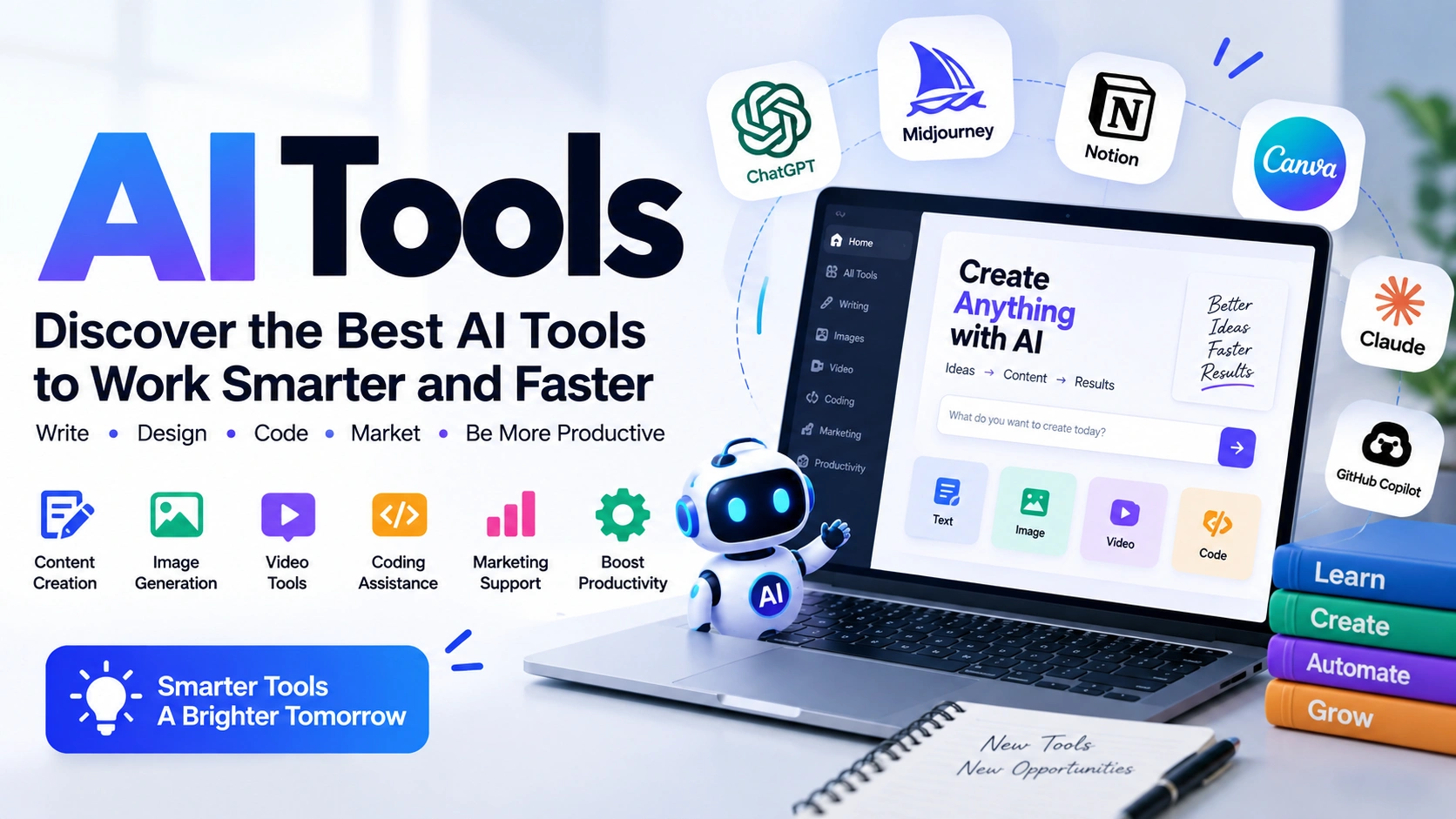
Artificial intelligence has quickly become one of the most useful technologies for everyday work. From writing and designing to coding, research, marketing, and productivity, AI tools can help people complete tasks faster while reducing repetitive work. Whether you are a student, content creator, freelancer, developer, marketer, or business owner, there is an AI tool available for almost every type of task.
The growing number of AI platforms can also make it difficult to decide which tool is worth using. Some tools are designed for specific tasks, while others provide multiple AI-powered features in one platform. In this guide, we will explore how AI tools work, the different types available, their benefits, and how you can choose the right tools for your needs.
What Are AI Tools?
AI tools are software applications that use artificial intelligence technologies to perform tasks that traditionally require human effort. Depending on the tool, AI can understand text, generate content, analyze information, create images, write code, summarize documents, translate languages, or automate repetitive tasks.
Many modern AI tools use technologies such as machine learning, natural language processing, computer vision, and generative AI. For example, an AI writing tool can generate an article based on a short prompt, while an AI image generator can create an image from a written description.
The main purpose of these tools is not simply to replace manual work. Instead, they can help users save time, generate ideas, automate repetitive processes, and improve productivity.
Why Are AI Tools Becoming So Popular?
The popularity of AI tools has increased because they can make complex tasks easier and faster. A task that might take several hours manually can sometimes be completed in minutes with the right AI solution.
For businesses, AI can help teams handle content creation, customer support, data analysis, marketing, and administrative work. For individuals, AI tools can assist with studying, writing, planning, designing, coding, and research.
Another reason for their popularity is accessibility. Many AI platforms offer simple interfaces where users can enter a prompt or upload information without needing advanced technical knowledge.
Types of AI Tools You Can Use
AI tools are available in many different categories. Choosing the right category depends on the task you want to complete.
AI Writing Tools
AI writing tools help users create, rewrite, summarize, and improve written content. They can be useful for blog posts, product descriptions, emails, social media captions, marketing copy, and other forms of written communication.
Some tools can also help with grammar, sentence structure, tone, and readability. Instead of starting from a blank page, users can provide a basic idea and use AI to develop it into a structured piece of content.
AI Image Generation Tools
AI image tools allow users to create images using text prompts. These platforms can be useful for marketers, designers, bloggers, social media creators, and businesses.
For example, a user can describe a product scene, illustration, advertisement concept, or social media graphic and ask an AI image generator to create a visual based on that description.
AI Video Tools
AI video tools are becoming increasingly useful for content creators and marketers. They can assist with video generation, editing, subtitles, voiceovers, scripts, and other production tasks.
Some platforms allow users to turn text into video concepts, while others can automatically edit clips or generate captions. This can reduce the amount of manual editing required for simple content projects.
AI Coding Tools
Developers can use AI coding tools to generate code, explain programming concepts, identify potential errors, and assist with debugging.
AI coding assistants can be helpful when working with languages such as JavaScript, PHP, Python, HTML, CSS, and other technologies. However, developers should always review generated code carefully before using it in a production environment.
AI Marketing Tools
AI marketing tools can help businesses with content ideas, keyword research, advertising copy, social media content, customer segmentation, and campaign planning.
For digital marketers, these tools can reduce repetitive tasks and provide additional ideas that can be reviewed and improved by a human marketer.
AI Productivity Tools
Productivity-focused AI tools can help users organize information, summarize meetings, create notes, manage tasks, and automate repetitive workflows.
These tools can be especially useful for professionals who regularly work with large amounts of information.
Benefits of Using AI Tools
One of the biggest advantages of AI tools is time savings. Instead of spending hours on repetitive tasks, users can use AI to generate a starting point and then focus on reviewing and improving the result.
Another major benefit is increased productivity. A person may be able to complete more tasks within the same amount of time when AI is used appropriately.
AI tools can also help with brainstorming. If you are struggling to find content ideas, marketing concepts, headlines, or design directions, an AI tool can provide multiple possibilities that you can evaluate.
They can also make certain technical tasks more accessible. Someone with limited coding experience, for example, may use an AI assistant to understand an error message or learn how a particular code snippet works.
How to Choose the Right AI Tool
With hundreds of AI platforms available, choosing the right one requires looking beyond popularity.
First, identify the exact problem you want to solve. If you need help writing articles, look for an AI writing platform. If you need graphics, explore AI image tools. If your main requirement is coding assistance, focus on AI developer tools.
Next, check the available features. Some platforms offer only one specific function, while others combine multiple AI capabilities.
Pricing is another important factor. Many AI tools provide free plans with limited usage, while premium plans may provide additional features, higher limits, or better models.
You should also consider ease of use, output quality, integrations, privacy policies, and whether the tool fits your existing workflow.
Free vs Paid AI Tools
Many AI platforms offer both free and paid versions. Free tools can be useful for beginners who want to experiment with AI without making a financial commitment.
Paid plans may provide additional features, increased usage limits, faster processing, better models, or access to advanced functionality.
The best option depends on how frequently you use the tool. If AI is an important part of your daily work, a paid plan may provide useful features. If you only need AI occasionally, a free option may be sufficient.
Before purchasing a subscription, it is a good idea to test the available free version or trial when one is offered.
AI Tools for Businesses and Freelancers
Businesses and freelancers can use AI tools across many areas of their workflow. A freelancer might use AI for creating proposals, generating content ideas, researching topics, preparing presentations, or writing basic code.
Businesses can use AI to support marketing, customer communication, internal documentation, research, and workflow automation.
However, AI-generated information should not automatically be considered accurate. Important business, financial, legal, or technical information should be reviewed before it is published or used for decision-making.
Tips for Getting Better Results From AI Tools
The quality of an AI-generated result often depends on the instructions provided to the tool.
Instead of entering a very short prompt, provide useful context. Explain what you want, who the content is for, the desired tone, the format, and any important requirements.
For example, instead of asking an AI tool to “write a blog,” you can specify the topic, target audience, word count, headings, tone, keywords, and purpose of the article.
It is also useful to review AI-generated content instead of publishing it immediately. Editing the output can make it more accurate, natural, useful, and relevant to your audience.
Are AI Tools Replacing Human Creativity?
AI tools can automate parts of creative and technical workflows, but human judgment remains important. AI can generate ideas and drafts, but people still need to decide which ideas are useful and how they should be presented.
Human creativity, experience, context, and critical thinking can make the final result more valuable.
The most practical approach is to treat AI as an assistant rather than blindly relying on it for every task.
Final Thoughts
AI tools are changing the way people work, create, learn, and manage everyday tasks. From AI writing tools and image generators to coding assistants, marketing platforms, video tools, and productivity solutions, there are now options for almost every type of workflow.
The key is to choose tools based on your actual requirements rather than simply following trends. Start with one or two tools, understand how they fit into your workflow, and evaluate the results before expanding your toolkit.
For anyone interested in discovering new AI software, comparing features, finding useful productivity solutions, or exploring tools for work and creativity, keeping up with the growing AI ecosystem can help you discover better ways to complete everyday tasks.
